Get Free Ebook Hidden in Plain Sight: What Really Caused the WorldÂ’s Worst Financial Crisis and Why It Could Happen Again, by Peter J. Wallison
Hidden In Plain Sight: What Really Caused The WorldÂ’s Worst Financial Crisis And Why It Could Happen Again, By Peter J. Wallison. In what instance do you like checking out so a lot? Exactly what regarding the kind of the e-book Hidden In Plain Sight: What Really Caused The WorldÂ’s Worst Financial Crisis And Why It Could Happen Again, By Peter J. Wallison The have to review? Well, everybody has their own reason ought to check out some e-books Hidden In Plain Sight: What Really Caused The WorldÂ’s Worst Financial Crisis And Why It Could Happen Again, By Peter J. Wallison Mainly, it will certainly associate to their necessity to obtain expertise from guide Hidden In Plain Sight: What Really Caused The WorldÂ’s Worst Financial Crisis And Why It Could Happen Again, By Peter J. Wallison and intend to read merely to get amusement. Stories, tale e-book, and other amusing publications end up being so popular this day. Besides, the clinical e-books will certainly additionally be the most effective reason to pick, specifically for the pupils, teachers, doctors, business owner, and also other careers who are fond of reading.
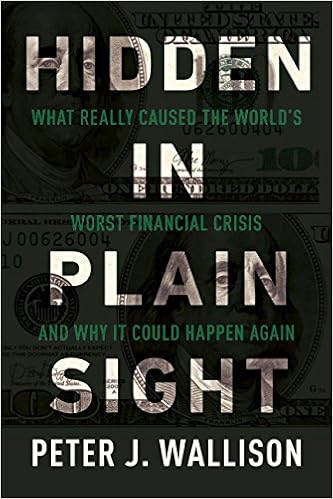
Hidden in Plain Sight: What Really Caused the WorldÂ’s Worst Financial Crisis and Why It Could Happen Again, by Peter J. Wallison

Get Free Ebook Hidden in Plain Sight: What Really Caused the WorldÂ’s Worst Financial Crisis and Why It Could Happen Again, by Peter J. Wallison
New updated! The Hidden In Plain Sight: What Really Caused The WorldÂ’s Worst Financial Crisis And Why It Could Happen Again, By Peter J. Wallison from the very best author as well as author is now readily available right here. This is guide Hidden In Plain Sight: What Really Caused The WorldÂ’s Worst Financial Crisis And Why It Could Happen Again, By Peter J. Wallison that will certainly make your day checking out becomes completed. When you are trying to find the published book Hidden In Plain Sight: What Really Caused The WorldÂ’s Worst Financial Crisis And Why It Could Happen Again, By Peter J. Wallison of this title in guide establishment, you might not find it. The troubles can be the limited versions Hidden In Plain Sight: What Really Caused The WorldÂ’s Worst Financial Crisis And Why It Could Happen Again, By Peter J. Wallison that are given up the book shop.
This publication Hidden In Plain Sight: What Really Caused The WorldÂ’s Worst Financial Crisis And Why It Could Happen Again, By Peter J. Wallison is anticipated to be among the best seller publication that will certainly make you really feel completely satisfied to acquire as well as read it for completed. As known could common, every book will have specific things that will certainly make someone interested a lot. Also it originates from the writer, type, material, and even the author. Nevertheless, many individuals also take the book Hidden In Plain Sight: What Really Caused The WorldÂ’s Worst Financial Crisis And Why It Could Happen Again, By Peter J. Wallison based on the style as well as title that make them astonished in. and also below, this Hidden In Plain Sight: What Really Caused The WorldÂ’s Worst Financial Crisis And Why It Could Happen Again, By Peter J. Wallison is really recommended for you because it has interesting title and also motif to review.
To conquer your issues in seeking for the brand-new details, a book will certainly help you ore. More functions as well as even more presence of guides to accumulates could provide special points. Yeah, publication can lead you for sure circumstance. It is not just for the particular things and also neighborhoods. When you have chosen what kind of books you intend to review, you could begin to get guide from now. Currently, we will share the link of Hidden In Plain Sight: What Really Caused The WorldÂ’s Worst Financial Crisis And Why It Could Happen Again, By Peter J. Wallison in this internet site.
This Hidden In Plain Sight: What Really Caused The WorldÂ’s Worst Financial Crisis And Why It Could Happen Again, By Peter J. Wallison has the tendency to be what you are required now. It will obtain to get rid of the existence of fascinating topic to review. Even many individuals really feel that this is not appropriate for them to review, as an excellent visitor, you could think about various other factors. This book is really good to read. It will not need to force you making depictive subject of the books. However, ideas as well as interest that are given kind this book can be achieved to everyone.
The 2008 financial crisis—like the Great Depression—was a world-historical event. What caused it will be debated for years, if not generations. The conventional narrative is that the financial crisis was caused by Wall Street greed and insufficient regulation of the financial system. That narrative produced the Dodd-Frank Act, the most comprehensive financial-system regulation since the New Deal. There is evidence, however, that the Dodd-Frank Act has slowed the recovery from the recession. If insufficient regulation caused the financial crisis, then the Dodd-Frank Act will never be modified or repealed; proponents will argue that doing so will cause another crisis.A competing narrative about what caused the financial crisis has received little attention. This view, which is accepted by almost all Republicans in Congress and most conservatives, contends that the crisis was caused by government housing policies. This book extensively documents this view. For example, it shows that in June 2008, before the crisis, 56 percent of all US mortgages were subprime or otherwise low-quality. Of these, 76 percent were on the books of government agencies such as Fannie Mae and Freddie Mac. When these mortgages defaulted in 2007 and 2008, they drove down housing prices and weakened banks and other mortgage holders, causing the crisis.After this book is published, no one will be able to claim that the financial crisis was caused by insufficient regulation, or defend Dodd-Frank, without coming to terms with the data this book contains.
Your recently viewed items and featured recommendations
›
View or edit your browsing history
After viewing product detail pages, look here to find an easy way to navigate back to pages you are interested in.
Product details
Hardcover: 432 pages
Publisher: Encounter Books (January 13, 2015)
Language: English
ISBN-10: 1594037701
ISBN-13: 978-1594037702
Product Dimensions:
6.5 x 1.5 x 9.2 inches
Shipping Weight: 1.8 pounds (View shipping rates and policies)
Average Customer Review:
3.8 out of 5 stars
228 customer reviews
Amazon Best Sellers Rank:
#440,299 in Books (See Top 100 in Books)
One of the best - perhaps the best - explanation of the financial collapse of 2008.Most "explanations" of the cause of the crash are really a description of "What" happened: packages of mortgages (which contained some bad stuff) being traded between banks and others, which led to a financial collapse, which led to an economic downturn.In his book Peter Wallison takes us back to what created the circumstances for the mortgage meltdown: The government policies - under both Clinton and Bush II - that forced the lowering of underwriting standards, in the intent of increasing homeownership. This resulted in a higher and higher percentage of subprime mortgages (the bad stuff). Without so much of the "bad stuff" in the mix, there could not have been the "mortgage meltdown". This book demonstrates that the subprime mortgages, almost by definition,were bound to fail. Wallison gives us one very telling statistic, for 30 years - right up to 1992, when the government push to issue subprime began - the US percent of home ownership was constant at 64%. By June 2008, it was slightly above 69%. Now, after the past six years of recession and foreclosures, it is back at the historic 64%. The subprimes made all the difference.Bankers and Economists are not the only readers who will benefit from this book. The casual reader will find very helpful thedefinitions and explanations of the terms that are batted around so freely by politicians and the "talking heads" on TV; Sub-Prime and Prime for starters. This truly is a book for all investors, homeowners, and taxpayers.
The lion’s work of my multi-year project reviewing all of the post-financial crisis books which I felt warranted review is long past, and my focus now is on my own work on the subject, targeting a 2017 release. The high volume of post-2008 books came between 2009 and 2011, and a few relevant stragglers entered the fray since then. Certainly the most noteworthy of the “latecomer†books on the crisis are the 2015 work of Peter Wallison, Hidden in Plain Sight: What Really Caused the World’s Worst Financial Crisis and Why it Could Happen Again. I refer to the work as noteworthy because it is a fine book with a highly valid contribution to the study of the crisis’ causation, but also because Wallison was an actual member of the government’s Financial Crisis Inquiry Commission, a preposterous waste of taxpayer money assembled by Congress in July 2009 to thoroughly investigate the crisis and its causes. It was not just a waste of money because the commission’s findings got everything wrong (Wallison admirably was the sole dissenter from the commission’s pre-baked conclusions), but also because the whole pre-text for the inquiry was to guide changes in policy that could stem the tide in the future. The Obama administration’s remedy to the financial crisis – the Dodd-Frank legislation – was rammed through Congress into law before this commission had even completed its work or submitted its findings. It was a show pony of an investigation, but it did nevertheless contain one Peter Wallison, and now several years later he has come out to give us his thesis on what really caused the crisis, and why he could not go along with the Congressional farce.His thesis is, in a nutshell, that it was government housing policy that caused the financial crisis. No shocker there. He essentially uses data point after data point after data point to incontestably prove that (a) 31 million “non-traditional†mortgages came into the American economy by 2008 (NTM being the more important classification than the media’s love of the term “subprimeâ€, as it combines where the real toxicity proved to be – in the combination of subprime with “Alt-A†– ‘alternatives to agencies’, or loans that didn’t mean the underwriting standards of Fannie/Freddie; these 31 million NTM’s were at the heart of the crisis; and (b) They were the direct result of government housing policy which created them into being; and (c) The mere existence of this massive bloc of troubled mortgages was bad enough, but the extensive effort to cover up their existence – to hide or suppress the real number of NTM’s in the system, – led to a very faulty climate for risk-taking; and (d) Efforts to continue legislating social mandates via government housing policy will continue to lead to economic instability and even repeated crises.That may have been a mouthful. It was certainly a mouthful to read his 361 pages of substantiation. But the basics of his conclusions are simple enough, and if left alone, not really problematic. There would have been no financial crisis without aggressive government mandates to increase lending where it did not belong, and that misguided belief that social policy could be administered through the economic experimentation of various lending mandates created an intensely malignant culture in the world of mortgage lending. Wallison further proves beyond any shadow of any doubt that Fannie Mae and Freddie Mac did not merely get “caught up in the pursuit of ill-gotten gains,†as is often alleged, mostly as an attempt to even blame free market greed for Fannie/Freddie’s decidedly non-free market troubles. Rather, Wallison proves, Fannie and Freddie got heavy into the NTM world because they had no choice if they were o meet their government mandates. I have read a dozen critiques of Wallison’s work, and none of them dispute his raw data in this regard.So with a useful book on misguided government social/housing policy as a core piece of the financial crisis, why do I need to find fault at all? The problem I have with this mostly fine work is that Wallison is not content to trust his own contentions about the crisis; he decides to conclude something more than the truth of his own thesis requires him to conclude. For Wallison, it is not just that government housing policy was a key piece, or the key piece, or a sine qua non in this crisis. For whatever reason, Wallison felt the need to additionally conclude that all other contributors to what became the 2008 crisis were not contributors at all – not in a complementary way, not in a supplementary way, not in a toxic accelerant way – they simply should be dismissed out of hand. This conclusion is frustrating to a thoughtful reader, for it is highly unnecessary for one also convinced of Wallison’s underlying work, and because it is simply preposterous on its face. The lengths Wallison goes to in order to claim that Federal Reserve monetary policy played no role in fertilizing the 2002-2006 housing bubble is cartoonishly silly. Perhaps no segment of the book is more disappointing than his completely indefensible supposition that there was no material inter-connectedness in the financial system, and that the CDS problem (credit default swaps) were easily remedied by one financial institution just replacing the CDS from one defunct firm (say, Bear Stearns) with a CDS from another healthy firm (he goes so far as to say a homeowner just needs to replace a bankrupt fire insurance company with another, never stopping to consider that in 2008 the entire business of this “fire insurance†was dead on arrival, since all of the companies were in over their heads with them, no one trusted each other’s marks, and surely no one wanted to write what had just brought down another firm (Bear, Lehman, etc.). My frustration with Wallison’s reckless conclusions that essentially all was well in Bear and Lehman land is not just how completely and empirically wrong they are, but how unnecessary they were for this book. He decided to throw out the “perfect storm†hypothesis about the crisis – the one that says it was the cocktail of government housing policy, Fed monetary policy, Wall Street leverage, rating agency corruption, and all other such assembled theories – and rather than conclude that nearly every problem which has been diagnosed in the financial crisis autopsy has some validity to it, even if some more culpability than others, he decides to discard all the others in their entirety. And in doing so, I fear, he loses incredible legitimacy for his very legitimate basic thesis.The financial crisis would have never happened without the accelerated attempt of Washington D.C. to legislate social policy through housing policy. One of the results of this fatal government initiative was a non-traditional mortgage glut that surpassed 31 million in number. The accompanying and unsurprising problems that these non-traditional mortgages created were the source of the financial crisis, and to the extent that Wallison’s book carefully and academically defends everything the prior three sentences say, his book was a helpful and needed work for students of the crisis (and a society that says they don’t want it to happen again). But the story as told in the preceding three sentences is not the whole story, as those 31 million NTM’s were the critical mass of an inter-connected financial system that levered up on insanity. They levered up on human greed, and I don’t mean the Wall Street banker kind of greed that wanted a bigger bonus. The financial system levered up on the greed of Main Street, that a covetous purchase of a home you could not afford was a good and noble thing, and it was our financial system’s bet on Main Street that proved fatal. Lehman’s collapse did not cause the financial crisis; it was caused by the financial crisis. After reading Wallison’s book readers will understand that crisis even more, but they will not understand it completely.
This book is must reading for anyone who continues to believe more and bigger government is the solution to all our problems. Until our leaders/politicians are willing to own up to and be honest about their own mistakes rather than trying to hide them through spin, Washington does not deserve our trust and confidence. This book is methodically researched and written to show the root causes of the 2008 mortgage crisis. It makes clear Washington's own culpability in causing the crisis and that subsequent investigations covered that up. It also makes the valid point that until Washington is honest with itself about the causes of a problem, it will be incapable of legislating solutions to prevent them from reoccurring in the future. Dodd Frank was passed to carry out an political agenda and did not put in place laws that would have prevented the mortgage crisis from occurring in the first place.
Absolutely flabbergasting. This book is non-stop facts and stats essentially debunking the current 2008 Crisis narrative. Wallison, who was on the FCIC investigation into the crisis, has expanded his dissenting position and supplemented it with internal memos, quotes from speeches and promotions showing just how the housing bubble was created and why.Fannie Mae and the politicians and activists behind the housing bubble are convicted by their own mouths. They say explicitly what they intend to do, then congratulate themselves on having done it, in speeches, in memos, in documented self-promotion. They were pleased as punch that they undermined sound underwriting standards and forcibly spiked the housing demand. When everything came crashing down they blamed the usual suspects, wall street greed and lack of regulation. The hypocrisy is stunning.This book is essential reading for anyone who wants to understand the 2008 crisis and the 2007 housing bubble.
Hidden in Plain Sight: What Really Caused the WorldÂ’s Worst Financial Crisis and Why It Could Happen Again, by Peter J. Wallison PDF
Hidden in Plain Sight: What Really Caused the WorldÂ’s Worst Financial Crisis and Why It Could Happen Again, by Peter J. Wallison EPub
Hidden in Plain Sight: What Really Caused the WorldÂ’s Worst Financial Crisis and Why It Could Happen Again, by Peter J. Wallison Doc
Hidden in Plain Sight: What Really Caused the WorldÂ’s Worst Financial Crisis and Why It Could Happen Again, by Peter J. Wallison iBooks
Hidden in Plain Sight: What Really Caused the WorldÂ’s Worst Financial Crisis and Why It Could Happen Again, by Peter J. Wallison rtf
Hidden in Plain Sight: What Really Caused the WorldÂ’s Worst Financial Crisis and Why It Could Happen Again, by Peter J. Wallison Mobipocket
Hidden in Plain Sight: What Really Caused the WorldÂ’s Worst Financial Crisis and Why It Could Happen Again, by Peter J. Wallison Kindle